
An eye serum OEM sample is useful only if it answers a decision. Before asking a factory to make one, write down the market, the product format, the feel you want, the pack you expect to sell, and the questions the sample must settle. Otherwise, two attractive lab samples can leave a buyer with no clear way to choose between them.
This checklist is for brand teams sourcing a private label eye serum for one or more Southeast Asian markets. It is not a formula specification or a substitute for local regulatory review. It is a way to make the first conversation with an OEM manufacturer more productive.
Decide what the first sample must prove
Start with one lead SKU. An eye cream, a light serum and an under-eye patch may belong in the same range, but they do not answer the same purchasing question. Shengda’s eye care product page lists these formats separately. For a first eye serum sample, choose the format and the decision you need to make next: texture, packaging fit, cosmetic positioning, or whether the proposed formula direction is worth developing further.
Name the destination country before discussing a label. “Southeast Asia” is a sales region, not one set of artwork or filing instructions. If you plan to sell in several countries, list them and decide which market the first pack and claim review will address. That makes it easier to spot where translation, ingredient checks or documentation may diverge later.
A useful first-sample goal might be: “Compare two light eye-serum textures for an AM routine, then test the preferred one in a proposed pump.” That is an illustrative brief, not a claim about an existing Shengda formula. It gives the development team a question to answer without prescribing an unverified ingredient percentage.
Give the factory a brief it can answer
Send the manufacturer a short written brief before requesting samples. It should be specific where your brand has made a decision and open where you need technical advice.
| Brief field | What the buyer should state | What the OEM should confirm |
|---|---|---|
| Market and channel | Destination country, online/retail/professional channel, launch sequence | Which proposed formula and pack details need market-specific review |
| Product format | Eye serum rather than a cream, gel or patch; intended AM/PM use | Feasible texture routes and any use limitations |
| Cosmetic positioning | Hydrating feel, smooth-looking finish or another clearly described cosmetic goal | Claims that can be supported and wording that needs evidence or revision |
| Sensory target | Weight, spread, tack, fragrance preference and how it should sit under makeup | What can be compared in the first sample round |
| Packaging route | Pump, airless pack or another preferred component; desired capacity if known | Component availability and formula-pack compatibility work needed |
| Commercial range | Target price position, estimated order range and desired decision date | Quotation basis, actual MOQ and timing after the route is reviewed |
Do not turn a mood board into an ingredient order. “Like this eye serum, but more premium” does not tell a chemist whether you mean a lighter after-feel, a different dispenser or a more restrained label. If an ingredient is non-negotiable, name it and explain why. If it is only a reference, say so.
Shengda describes its OEM/ODM workflow as project brief, formula direction, sample review, packaging plan and production. A brief that separates fixed requirements from open questions fits that sequence better than a request for “the best eye serum.”
Evaluate the serum in its intended pack
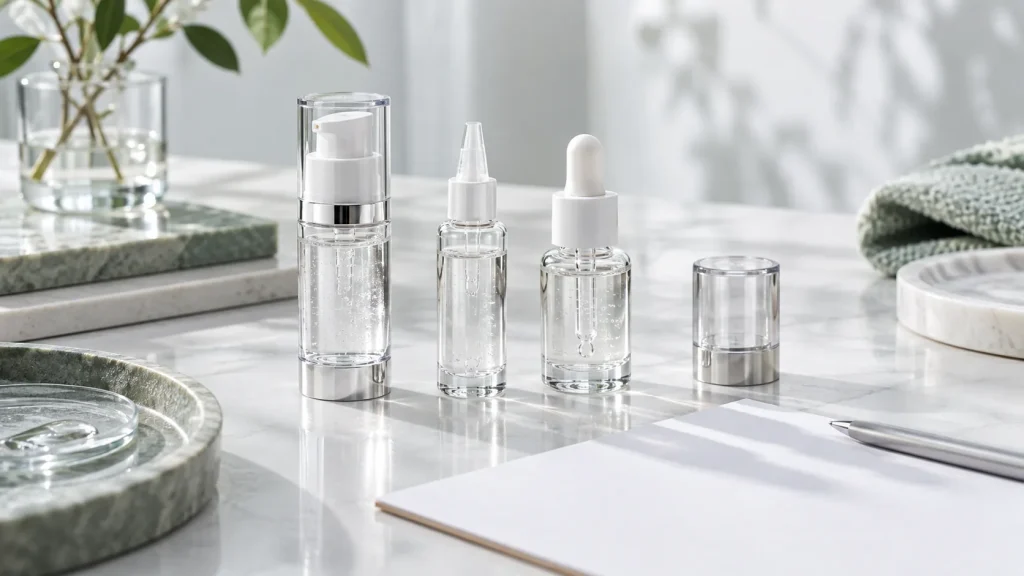
A laboratory vial tells you something about texture. It does not settle how the finished product dispenses. Once a formula direction is promising, ask for the proposed packaging route to be reviewed with that formula, not only as an empty component shown beside it.
For a pump, note the first-use priming, amount delivered, residue at the outlet and whether the dose feels sensible for the eye area. For a dropper, look at control, neck wiping and the risk of dispensing too much. Check whether the serum pills under the makeup or skincare your target customer is likely to use. These are evaluation questions, not claims that a given pack or formula has already passed a test.
Keep a record of exactly what was reviewed: sample version, date, formula reference, component reference and evaluator. When feedback says “less sticky,” the manufacturer should know which version and which pack produced that impression. If the container changes, ask which compatibility or stability checks need repeating before commercial approval.
Use a sample review scorecard
Have the same people use the same criteria for each version. The scorecard does not need a pretend scientific precision. A short observation and a clear pass/revise decision are more useful than a row of unexplained numbers.
| Check | Record after each sample | Decision owner |
|---|---|---|
| Texture and spread | Does it move and absorb as the brief requested? | Brand/product team |
| Finish after use | Tacky, greasy, comfortable or drying under the planned routine? | Brand/product team |
| Layering | Any visible pilling with the products used in the trial? | Brand/product team |
| Dispensing | Is the dose repeatable and the outlet clean after use? | Brand and packaging supplier |
| Appearance in pack | Any change in colour, separation or visible residue during the agreed review period? | Manufacturer and buyer |
| Claim and label direction | Does the proposed wording stay within the agreed cosmetic positioning? | Brand’s local regulatory reviewer |
| Open work | Which questions require formal testing, documents or another sample? | Named owner on each side |
Do not call a sample “approved for sale” because a small internal group liked its feel. Sensory approval, final formula approval, filled-pack checks and destination-market requirements are separate decisions. Agree on the next gate in writing.
Separate factory documents from market responsibilities
Before locking artwork, ask who will prepare the ingredient list, manufacturing and quality documents, claim support and product information materials for the destination market. Do not assume that a factory certificate replaces a market notification or that one country’s completed file automatically covers another.
For example, Singapore’s Health Sciences Authority says cosmetic products generally need notification before supply and directs applicants to check ingredients and labelling against the ASEAN Cosmetic Directive. Malaysia’s NPRA Product Information File guidance lists information on presentation, manufacturing, finished-product quality, safety and claim support. These sources illustrate why the destination and responsible local party should be settled early. They do not establish the procedure for every Southeast Asian country or confirm that Shengda files notifications on a buyer’s behalf.
Ask your local regulatory adviser which documents are required for your exact formula, claims and market. Then ask the factory which of those it can supply, in what form, and at what stage. This avoids treating “we can provide documents” as a complete answer.
Send a brief that can lead to a useful sample
Shengda lists eye serum among its private label eye care directions and describes a process that includes formula discussion, sample review and packaging planning. To start a specific project, send one page containing your target market, intended user, serum texture, cosmetic claim direction, packaging preference, estimated quantity range and the decision the first sample must support. Use the general manufacturer buyer checklist if you are still comparing suppliers.
Ask for a reply that separates what Shengda can already discuss from what needs a formula or component review. MOQ, sample timing, testing and documentation should be confirmed for the actual project rather than lifted from another product category.
Do I need to specify every active ingredient before asking for samples?
No. State the product goal and any ingredient or exclusion that is genuinely fixed. Ask the formulation team for feasible routes, then review ingredient choices and claim support before approving a final concept.
Can one sample be used for several countries?
It can be a common starting point for evaluation, but it is not proof that one finished formula, label and notification route suits every country. List your markets and arrange the local checks before locking the commercial pack.
When should the packaging be approved?
After the preferred formula has been reviewed in the intended component and the necessary compatibility, quality and market checks are agreed. An attractive empty bottle is not a filled-product approval.
If you are ready to compare an eye serum concept, send Shengda the one-page brief. Ask the team to identify the first sample decision and the information still needed for a project-specific quotation.